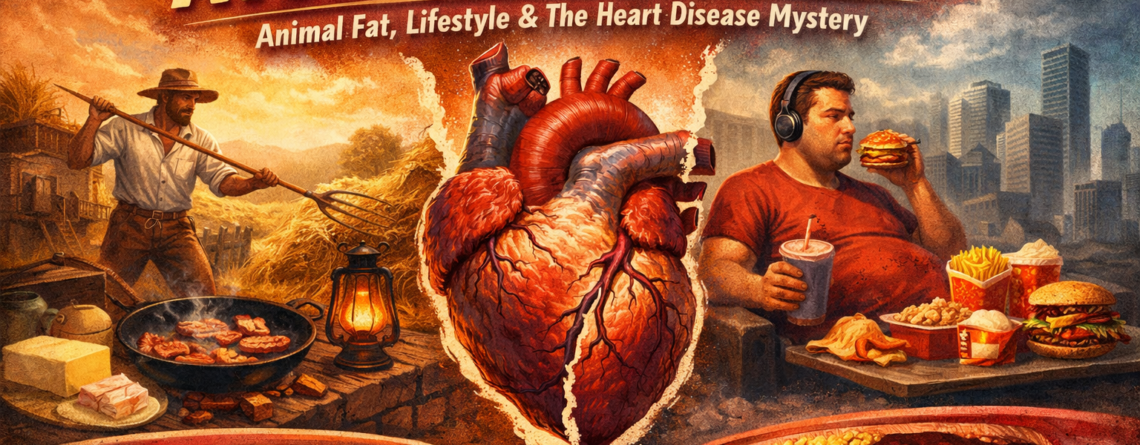
If Animal Fat Was So Dangerous, Why Didn’t People in the Past Have Heart Disease?
This question appears constantly in nutrition debates and social media commentary:
“People used animal fat for centuries and didn’t suffer from cardiovascular disease. Now we have heart disease everywhere. What changed?”
At first glance, the argument feels intuitive. But when examined through nutritional science, physiology, epidemiology, and behavioural neuroscience, the claim collapses. The issue isn’t animal fat versus seed oils — it’s context, exposure, and systems biology.
Let’s unpack what researchers actually know.
1. The illusion of a healthier past
The idea that cardiovascular disease (CVD) was rare in the “olden days” relies on a false historical comparison.
Three critical facts are usually ignored:
People didn’t live long enough Heart disease wasn’t diagnosable Most deaths occurred before atherosclerosis could manifest
In pre-industrial societies, average life expectancy hovered around 40–50 years. Atherosclerosis is a slow, cumulative process, often requiring 50–70 years of exposure before clinical events (heart attacks, strokes) occur.
You cannot observe age-related diseases in populations that do not reach old age.
This is not metabolic protection — it’s demography.
2. Heart disease existed — it just wasn’t named
Modern cardiology relies on tools that didn’t exist historically:
ECGs Blood lipid panels Imaging Cardiac biomarkers
People who died suddenly were often described as dying from:
“Old age” “Chest weakness” “Dropsy” “Sudden collapse”
Autopsy data from the early 20th century (when they became common) revealed advanced atherosclerosis in many individuals who had never been diagnosed with heart disease during life.
The disease was present. The language and technology were not.
3. Animal fat wasn’t consumed in excess — energy balance mattered
Yes, animal fats like butter, tallow, and lard were commonly used. But researchers emphasise dose and metabolic context, not ingredients in isolation.
Historical conditions:
Chronic caloric scarcity Seasonal food insecurity Physically demanding labour Minimal snacking No ultra-processed food environment Leaner animals, smaller portions
Contrast that with today:
Persistent caloric surplus Sedentary behaviour Continuous eating High palatability foods Fat + refined carbohydrate combinations
From a metabolic standpoint, saturated fat in energy balance behaves very differently than saturated fat in chronic overconsumption.
4. Physical activity changes lipid metabolism profoundly
From a physiological perspective:
High daily energy expenditure increases lipoprotein clearance Insulin sensitivity remains high Visceral fat accumulation stays low Endothelial function is preserved
Pre-industrial humans often walked 10–20 km per day, lifted, carried, farmed, and laboured manually. This radically alters how dietary fat is handled.
Modern inactivity amplifies:
LDL particle retention Insulin resistance Chronic inflammation Endothelial dysfunction
This is systems physiology, not a single nutrient story.
5. Heart disease rose before seed oils entered the diet
This point is often overlooked but is crucial.
Cardiovascular mortality began rising in the early 1900s Widespread vegetable oil use occurred decades later The rise correlates strongly with: Increased life expectancy Smoking Urbanisation Refined sugar and flour Reduced physical activity
Chronology alone disproves the claim that modern oils “caused” heart disease.
6. What controlled studies actually show about fat
When researchers isolate variables under controlled conditions:
Saturated fat raises LDL cholesterol LDL causally contributes to atherosclerosis Replacing saturated fat with polyunsaturated fat: Lowers LDL Reduces cardiovascular events Does not increase systemic inflammation
These findings are consistent across:
Randomised controlled trials Genetic studies Pharmacological LDL-lowering trials
Biology is conserved across time. Human arteries have not changed in 200 years.
7. The role of survivorship bias
From a cognitive psychology standpoint, the argument suffers from survivorship bias.
We remember:
The strong farmer who lived to 80 The resilient grandmother who cooked with butter
We forget:
Infant mortality Maternal death Midlife deaths Entire cohorts lost to infection and famine
Anecdotes survive. Populations do not.
8. Why this myth feels so compelling
Neuropsychologically, humans prefer:
Simple villains Naturalistic explanations Moralised food narratives Nostalgic certainty
“Natural fat was fine, modern food is poison” reduces cognitive load. But biology doesn’t operate on intuition.
The scientific bottom line
People in the past did not avoid heart disease because of animal fat.
They:
Died younger Ate less Moved far more Lacked diagnostic tools Accumulated far less lifetime metabolic stress
Modern cardiovascular disease reflects longevity plus chronic overnutrition and inactivity, not a betrayal of traditional fats.