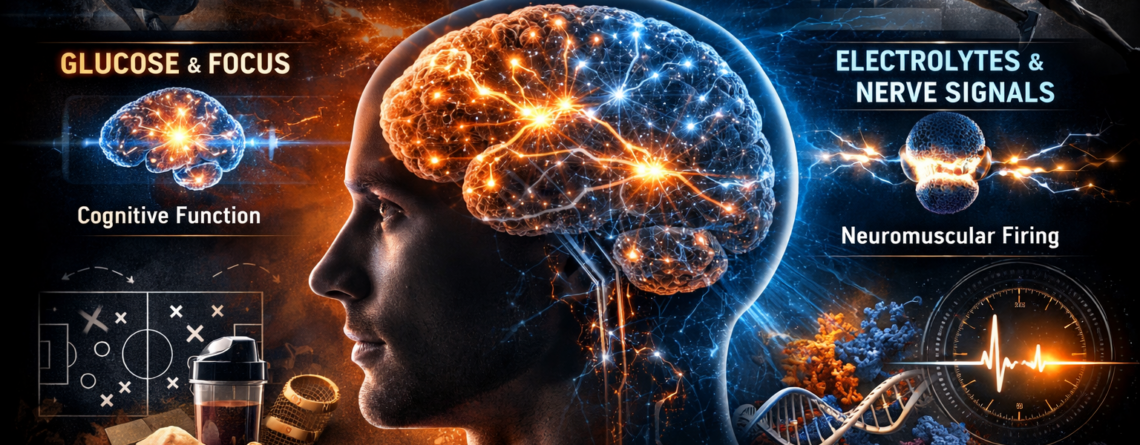
Neuroenergetics in Sport: Why Peak Performance Begins in the Brain
For decades, performance in sport has been framed through a muscular lens: strength, power, hypertrophy, VO₂ max. Yet beneath every squat, sprint, strike, or serve lies a more decisive system — the central nervous system.
Performance is not merely mechanical. It is neurobiological.
Welcome to the era of neuroenergetics in sport and exercise nutrition.
The Brain: The True Performance Regulator
The brain accounts for only ~2% of body mass, yet it consumes roughly 20% of total energy expenditure at rest. During complex motor tasks, tactical decision-making, and competitive stress, cerebral energy demand increases even further.
Every athletic movement begins as an electrical impulse:
Motor cortex activation Corticospinal tract signalling Motor unit recruitment Neuromuscular junction transmission
Without sufficient substrate availability, signal precision declines. Reaction time slows. Perceived exertion rises. Decision-making becomes erratic.
This is why elite performance cannot be separated from metabolic support of the brain.
Glucose: More Than “Energy”
Glucose is the brain’s primary fuel source under normal physiological conditions. However, in sport, its role is far more nuanced than simple caloric provision.
Adequate carbohydrate availability supports:
Prefrontal cortex function (executive decision-making) Working memory efficiency Reaction latency Attentional control under fatigue
When blood glucose declines, we often see increased impulsivity, reduced tactical discipline, and heightened central fatigue perception. In high-skill sports — combat sports, team invasion games, racquet sports — this cognitive drop can determine outcomes.
Carbohydrate periodisation is therefore not only about glycogen replenishment. It is about maintaining cognitive bandwidth during training and competition.
Electrolytes: The Architecture of Neural Signalling
Sodium, potassium, calcium, and magnesium are not simply hydration buzzwords. They are the biochemical architects of action potentials.
Neural transmission depends on ionic gradients across cell membranes. These gradients enable:
Depolarisation Signal propagation Neuromuscular coordination Muscle fibre synchronisation
Even mild dehydration can impair cognitive performance and motor accuracy. Electrolyte imbalance alters membrane excitability, affecting both precision and force output.
In explosive disciplines — sprinting, martial arts, weightlifting — microsecond inefficiencies in neuromuscular firing can separate gold from silver.
Hydration strategy, therefore, is a neurophysiological strategy.
Protein, Amino Acids & Neurotransmitter Dynamics
Protein is often reduced to muscle protein synthesis. But amino acids are also precursors for neurotransmitters:
Tryptophan → Serotonin Tyrosine → Dopamine & Noradrenaline Glutamine → Glutamate & GABA regulation
These neurotransmitters influence motivation, arousal, reward processing, focus, and sleep architecture.
Poor recovery nutrition doesn’t just slow tissue repair — it disrupts neurochemical balance, which affects mood, resilience, and training consistency.
An athlete’s ability to tolerate load is partly psychological — but psychology itself is biologically mediated.
Central Fatigue: Where Nutrition Meets Perception
Fatigue is not purely muscular. The Central Governor Model and related neurophysiological frameworks propose that the brain regulates performance output to protect homeostasis.
When substrate availability declines or inflammatory markers rise, the brain increases perceived effort — effectively “downregulating” performance.
This means:
Nutritional adequacy influences perceived exertion. Anti-inflammatory strategies influence recovery signalling. Sleep quality (nutritionally supported) influences motor learning consolidation.
Performance limitation is often a protective neural mechanism — not simply muscle failure.
The Brain–Body Integration Model of Performance
To optimise performance, we must think in systems:
Nutrient Strategy
Neural Outcome
Performance Outcome
Carbohydrate timing
Stable cortical activity
Sharper decision-making
Electrolyte balance
Efficient action potentials
Precise motor control
Adequate protein intake
Neurotransmitter support
Enhanced motivation & recovery
Omega-3 fatty acids
Membrane fluidity & reduced neuroinflammation
Improved reaction time &
The body does not operate in compartments. Muscle contraction, cognition, emotion, and motivation are integrated within a single adaptive system.
The Future of Sport Nutrition
The next evolution in sport science will not be about bigger supplements or trend-based diets. It will be about:
Nutritional periodisation aligned with cognitive load Brain-focused recovery protocols Monitoring neurocognitive markers alongside physical metrics Personalised fuelling strategies based on training intensity and psychological stress
Peak performance is not simply force production. It is neural efficiency under pressure.
Final Thought
The gym builds muscle.
The pitch reveals skill.
But the brain orchestrates both.
When we fuel the nervous system intelligently, we do more than enhance physical output — we optimise perception, anticipation, resilience, and execution.
True high performance begins at the synapse.